
Skid Mounted Water Treatment Plants for Remote Locations
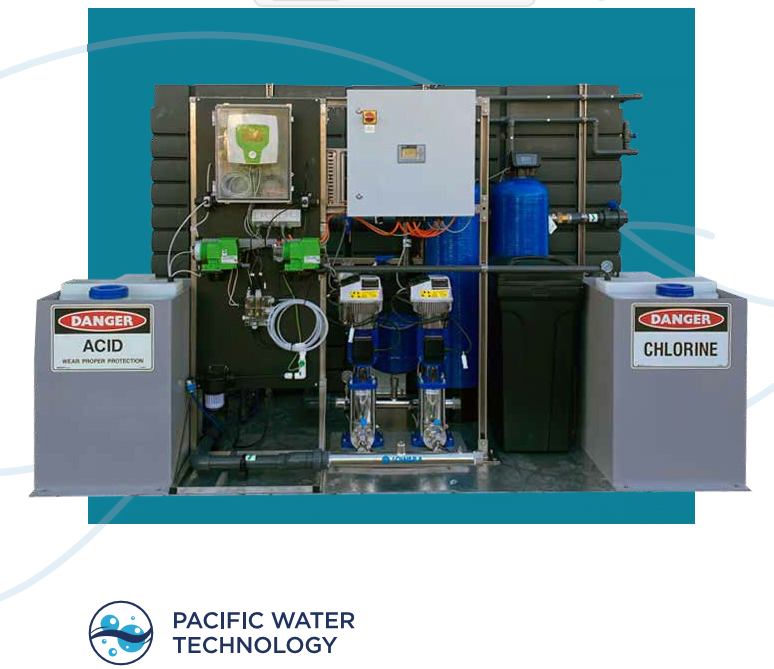
Pacific Water Technology recently completed water treatment skids for potable water supply for regional hospitals. These skids were designed in such a way that minimal work was required at the remote sites. The chlorination skids included automated dosing of acid and chlorine at the required set-points using pH and free chlorine as control parameters. The accurate control of the desired free chlorine level was achieved, by recirculating water in two buffer tanks that each hold around 4000 l of water. The water is recirculated using two pumps (duty/stand-by) that pump the water into each tank 24/7 maintaining the required set-points. Both tanks can be individually isolated for routine maintenance and sanitation. The build-up of sediment within the tanks is minimised by having a 5-micron bag filter at the raw water connection, that constantly tops up the tanks. For hard water areas, a water softener is also added at the raw water side. The water is sampled using a side-stream, monitoring pH, Free Chlorine, Conductivity, Temperature and ORP. Other parameters that are monitored at the discharge side, are pressure and water flowrate. A Centurio control panel displays all the parameters, as well as alarms if the values are not within range. This controller also includes Modbus and capability for BMS connection. Two constant pressure variable speed Lowara pumps provide the water flow rate at the required flow and pressure to the various points of usage within the hospital. A central control panel with PLC provides outputs for pump status, as well as a smart controller that alternates the two recirculating pumps.

Some water treatment skids, have some variations to suit the water quality of the raw water. In some cases, a water chiller has also been added to maintain water temperatures below 20 degC.
These water treatment skids are being supplied to various remote locations, including St. George, Morven, Blackwater and Commonweal. The design incorporates the latest technology and first tier components have been selected to ensure reliable operation. These water treatment plants have also been designed to reduce the risk of Legionella, providing capability to administer periodic hyperchlorination.